
Nail Polish SEO Case Study
How we scaled ORLY's organic traffic from 30,000 to 165,000 monthly clicks in just 9 months
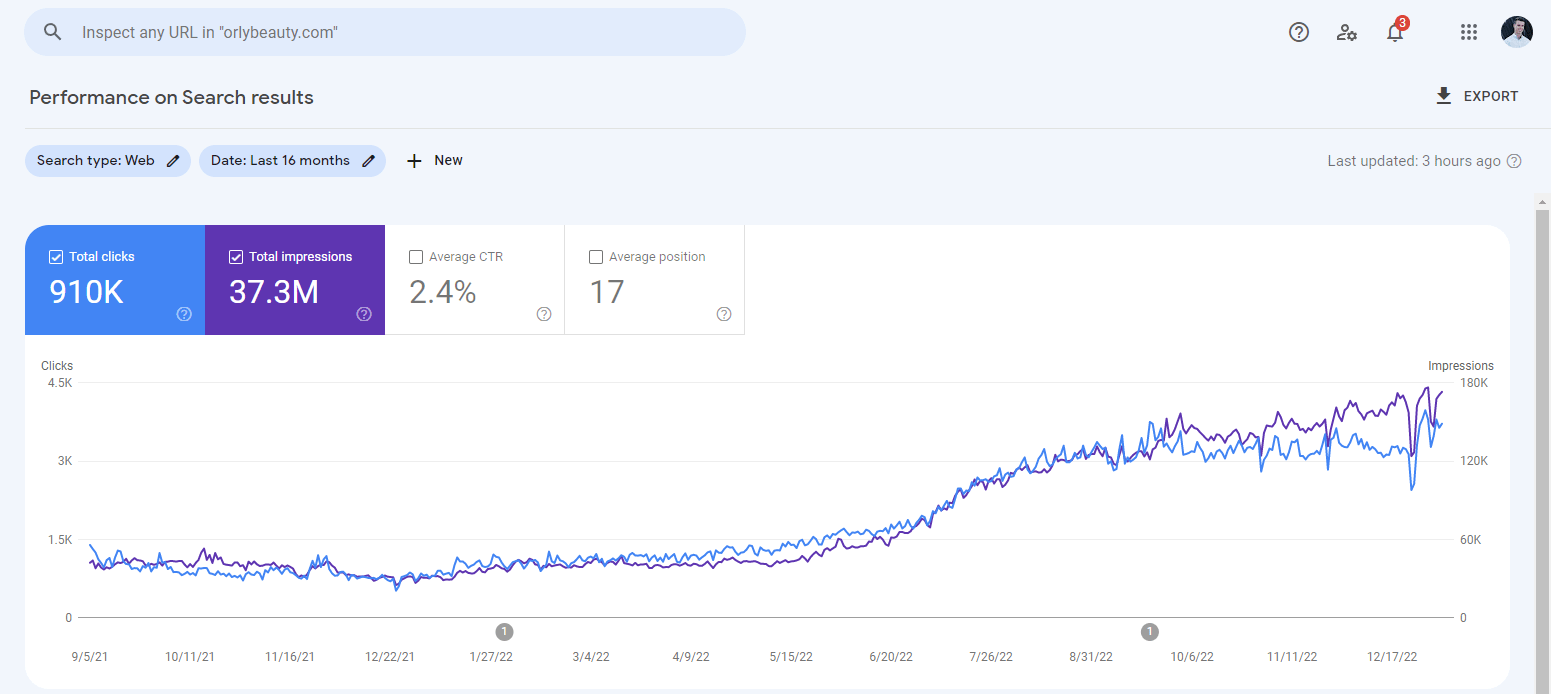
OrlyBeauty.com is a privately owned nail polish company that has been around for over 40 years, with a legacy, massive amounts of PR, and practically no content strategy. After a full SEO audit, a meta title and description template for every product page, and a planned content library, its organic traffic scaled from 30,000 to 165,000 monthly clicks in nine months.
The Brand & The Challenge
Forty years of legacy and PR, with practically no content strategy
We were approached by OrlyBeauty.com, a privately owned nail polish company that's been around for over 40 years, a brand with a legacy, massive amounts of PR and practically no content strategy. We were over the moon when we landed this project.
After the initial mini audit, and talking with the client, we identified four issues and opportunities: a poor technical and on-page SEO foundation, insufficient keyword research and keyword mapping, dozens of cases of keyword cannibalization, and no content marketing or content planning done.
The Approach
A six-step process, from a full audit to link building
In order to resolve these issues, and generate results for the client, we followed our 6-step process. Steps 1 to 4 were done at the start of onboarding, and steps 5 and 6 are done every month.
- 01
Run a full Shopify SEO audit
Whenever we start working on a new Shopify SEO project, we always start with our full SEO audit, which covers over 285 on-page, off-page, and technical SEO factors and opportunities. In the case of OrlyBeauty.com, they had tons of unresolved technical SEO issues, along with on-page issues, keyword cannibalization and poor collection and product page SEO.
- 02
Implement every fix, done for the client
After identifying all the issues and opportunities, we jumped straight in and started resolving them for the client. We offer a done-for-you solution, so the client didn't need to involve their development team: our team handled everything, saving the client's time so they could focus on other tasks on their plate. It took about 21 days to resolve all of the on-page, off-page, and technical SEO issues, as well as keyword cannibalization.
- 03
Apply a meta title and description template to every product page
Another issue OrlyBeauty.com was dealing with was unoptimized pages. There hadn't been much attention paid to optimizing specific pages for specific keywords, which is understandable when one of the main channels is paid advertising, which doesn't require keyword optimization the way SEO does. Even without keyword mapping, the store was getting decent organic traffic, but there were a lot of opportunities to lift it further. We researched all of the brand's top performing organic collection and product pages, as well as all of the top performing pages of our competitors. We came up with a template for the meta titles and descriptions of product pages that would capture the most relevant money keywords, and then applied it to every single product page, which instantly boosted rankings.
- 04
Research keywords and plan content at scale
We dedicate an entire step to content planning because it's one of the most important parts of the process, especially when we write anywhere between 30,000 and 100,000 words a month for our clients. For OrlyBeauty.com we planned a ton of content, all related to frequently asked nail polish questions, covering everything from how to apply and remove nail polish to nail polish trends and style guides. We exported over 300,000 keywords, filtered them, clustered them by intent, and organized them into SILOs and article groups. Interlinking all the relevant articles in the same SILO improves topical relevancy further.
- 05
Write, upload, and publish every month
After the content plan, we move on to writing, following a 5-page SOP that comes down to four steps. First, identify search intent: open the target keyword in an incognito window, work out why someone is searching it, and position the entire article around answering that. Second, outline: click through the top 5 to 10 results on page one and cover all of their topics and subtopics in one article, so it's the most in-depth on the topic. Third, link to at least 5 of the key collection and product pages we optimized earlier, which improves UX and sends referral traffic and link juice to them. Fourth, interlink the article with the others in its SILO, using keyword variations as anchors, so Google understands their context better. For more on writing and optimizing posts, see our guide to blogging on Shopify and optimizing for SEO.
- 06
Leverage the domain authority Orly already had
Most SEOs would place link building at the top of their list, but we prefer to focus on it after the first batch of articles goes live, not because content matters more than links, but because we get a higher ROI on links after publishing new content. Our go-to strategy is PR and outreach: we get the client featured in relevant media publications through guest posts, write the content ourselves, and optimize each post for specific keywords so it ranks and gets traffic too, because a guest post with traffic is significantly more valuable than one without, no matter the DR of the domain. Because Orly had massive domain authority prior to starting the project, though, we didn't have to invest a dime into link building. That made this SEO campaign even more efficient in terms of budgeting, as we were able to leverage the domain authority that was built previously through all the years of hard work and PR.
The Results
From 30,000 to 165,000 monthly clicks in nine months
After about 3 months, the results from the audit and implementations really started to kick in. With all of the keyword-targeted content and niche-specific link building, we really started dominating more and more of our target keywords.
Following the exact steps above allowed us to scale Orly's organic traffic from 30,000 to 165,000 monthly clicks in only 9 months.
The Foundation
Content built the topical relevancy behind the traffic
The reason we're so aggressive with the amount of content we write and publish is not only because it's the fastest way to get tons of traffic and opt-ins, which are then converted into sales, but also because we're able to quickly become a topically relevant site in the eyes of Google, and once you achieve topical relevancy, SEO becomes really easy. Topical relevancy is achieved when you cover a topic so extensively that Google learns you're one of the best sources online for that topic, and then hands over the rankings.

Shopify SEO
Want results like these for your Shopify store?
We'll show you the technical, content, and authority gaps holding your store back, then give you a practical order for fixing them.
Get A Free SEO & AI Growth Strategy