
Telehealth
We took a $59M-funded telehealth company from 2,300 to 93,000 organic visits a month
Berry Street connects US patients with registered dietitians over video, billed through insurance so most patients pay $0. When GoldenWeb started, organic search was almost non-existent. Twenty-one months later it was producing over half a million dollars a year in equivalent paid-search value, and roughly 4,800 incremental patient bookings a year, which is now an asset the company owns rather than rents.
Berry Street has raised $59.2M, backed by
$50M Series B, January 2025 · plus angels including the founder of Revolut and the co-founders of Spring Health and Grow Therapy
Client Testimonial
“We were starting from close to zero, fewer than ten pages on the site, no offsite link building, nothing optimized from a technical standpoint. GoldenWeb analyzed our site and came back with a clear list of things to fix, and it didn't stop there, every month, new recommendations, and if we didn't act on them, they'd follow up and hold us accountable. Our domain authority is now at the same level as our biggest competitors, even though they'd had a significant head start on us. We highly recommend GoldenWeb here at Berry Street. If you're considering working with them, the one thing I'd call out is the consistency.”
Alexander Andersen, Head of Growth Marketing, Berry Street
The Company & The Challenge
Little to no organic presence, paired with increasing customer acquisition costs
Berry Street had already solved the hard part, it built an insurance-covered nutrition therapy platform across 1,250+ insurance plans, grew to roughly 294 employees, and raised $59.2M, including a $50M Series B in January 2025 co-led by Sofina and Northzone.
What it did not have was channel diversity. Patient acquisition ran almost entirely through paid social and paid search, which meant growth was priced at auction and every incremental patient cost roughly what the last one did. Organic search contributed almost nothing that wasn't branded, which meant that acquisition was getting more and more expensive day after day.
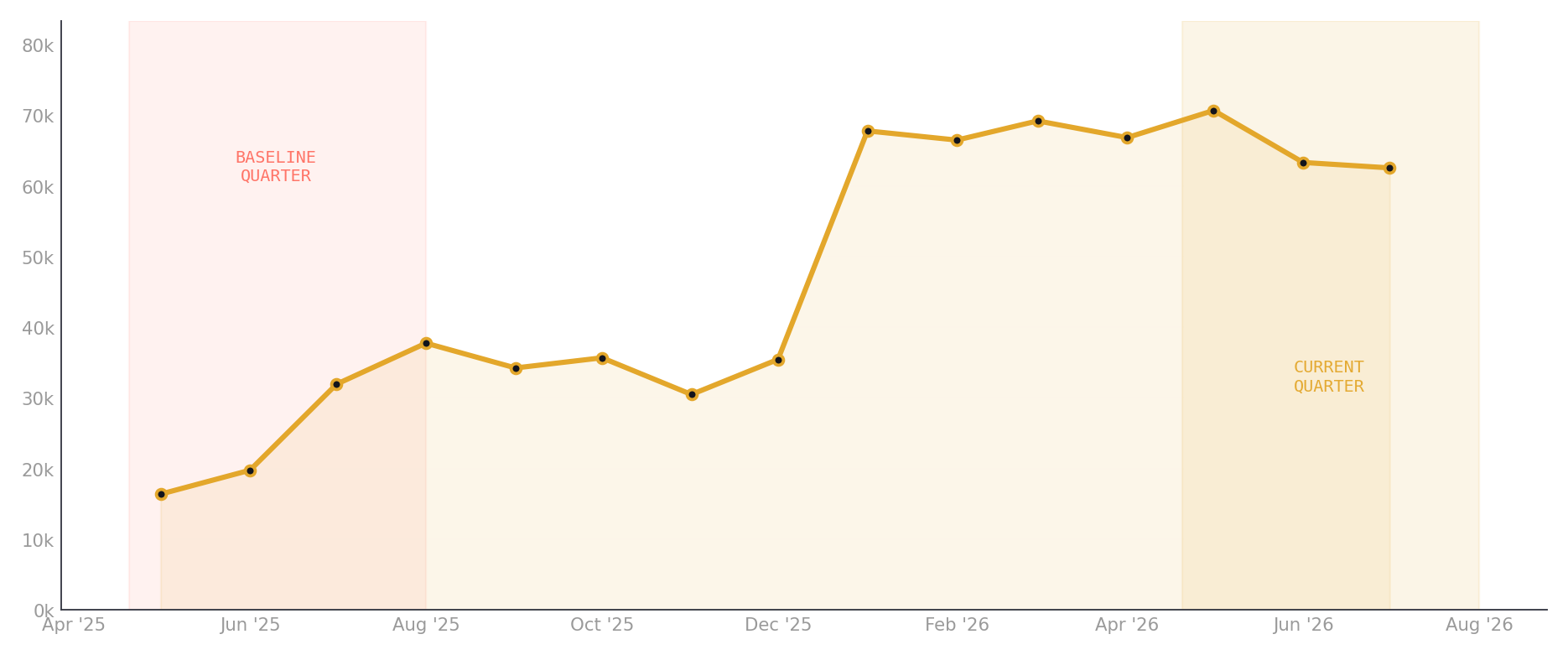
In August 2024 the entire site drew an estimated 2,300 organic visits a month and ranked for 561 keywords, 42 of them on page one. In a category where patients search in plain English, "does my insurance cover a dietitian," that was a very large amount of free, high-intent demand being handed to well-funded competitors.
The Approach
Build the pages that intercept insurance intent. Then prove to Google we're worthy of ranking
Healthcare marketing carries constraints most categories don't: payer brand restrictions, clinical review on every published word, HIPAA limits on what you can even measure. The strategy had to be built inside those constraints, while keeping the eyes on the prize.
- 01
Technical foundations first, on a platform that isn't SEO spotless out of the box
The site runs on Framer, which offers no native canonical tags and no robots.txt control. Duplicate homepage clones de-indexed, redirects rebuilt, crawl waste removed, before a single new page went live.
- 02
A landing page for every payer, every condition, every city
143 commercial pages mapped to real search demand, one per insurance carrier, one per clinical specialty, one per metro. If a patient can search it, there is a page built to answer it and a booking CTA on it.
- 03
At least one backlink to every new page, every month
New URLs carry no authority and Google is slow to trust them. 458 live placements across 449 unique domains, prioritised by which pages were newest and most commercial.
- 04
Editorial content built as demand capture, not brand fluff
Keyword-clustered silos on weight loss, meal planning and GLP-1s, the questions patients ask months before they book each interlinked with the commercial pages that convert. Informational content builds trust with Google & AI chatbots, the interlinked money keywords and CTAs convert them, when they're ready. Articles carried a CTA or an email opt-in to warm the traffic up, and visitors were then retargeted through Berry Street's Meta ads, so organic fed the paid funnel as well as reducing reliance on it.
- 05
Clinical review baked into the publishing pipeline
Every article routed through Berry Street's own dietitians before publication, with medical disclaimers and FAQ structure. Nothing was published, that couldn't survive a compliance review.
- 06
Measurement rebuilt around non-branded performance
Custom reporting separating branded from non-branded clicks, keywords and bookings, so the channel could be judged on non-branded traffic performance - the main lever an SEO agency has control over.
The Breakdown
“With SEO, you start off slow, but it compounds and that compounding stays.”
Benjamin Strusnik, Founder, GoldenWeb
The Results
Month one versus peak month
The cleanest way to read this engagement is to put the month it started next to the best month it produced.
| Metric | Before | After |
|---|---|---|
| Estimated organic visits / month | 2,300 | 93,400 |
| Ranking keywords | 561 | 19,897 |
| Page-one keywords | 42 | 11,006 |
August 2024 vs. peak month, 2026. Traffic grew +3,891%; overall visibility grew +3,447%, two independent measures landing in the same place. Measured directly in Google Search Console, the peak month delivered 70,660 organic sessions against 16,381 in the earliest month on record; 744,938 organic sessions total across the tracked window.
The Economics
What that traffic is worth, this year, and the years ahead
Organic sessions are only interesting if they price against something. Two independent valuations, neither of which requires you to take our word for it.
Replacement cost. Weighting every keyword Berry Street now ranks for by its cost-per-click gives a blended CPC of $0.65 - $2.26 across the commercial and transactional subset. In the trailing twelve months alone, buying that traffic through Google Ads would have cost $416,000. At the current monthly run rate it prices at $511,000 a year. That is a recurring media line item this channel removes, not a one-time saving.
Patient bookings. Organic-attributed bookings grew from roughly 100 a month at the start of the engagement to around 500 a month - a 500% increase, tracked in monthly reporting throughout. Against a flat pre-engagement run rate that is approximately 4,800 incremental patient bookings per year, and roughly 5,900 across the engagement to date.
At typical medical nutrition therapy reimbursement, and assuming only a single billed session per patient, 4,800 bookings represents on the order of $480,000 of reimbursed revenue a year. Assume the two-to-three session courses standard in this category and the figure is multiples of that.
Booking figures are modelled. Google Search Console holds keyword data and GA4 holds the conversion event, with no join key between them, so no platform can attribute a booking to the query that produced it. The model interpolates between four measured monthly booking counts from client reporting and assumes a flat counterfactual. Treat it as a range, not a decimal. Reimbursement figures are US industry averages, not Berry Street's contracted rates.
The Foundation
Authority that you can't replicate overnight
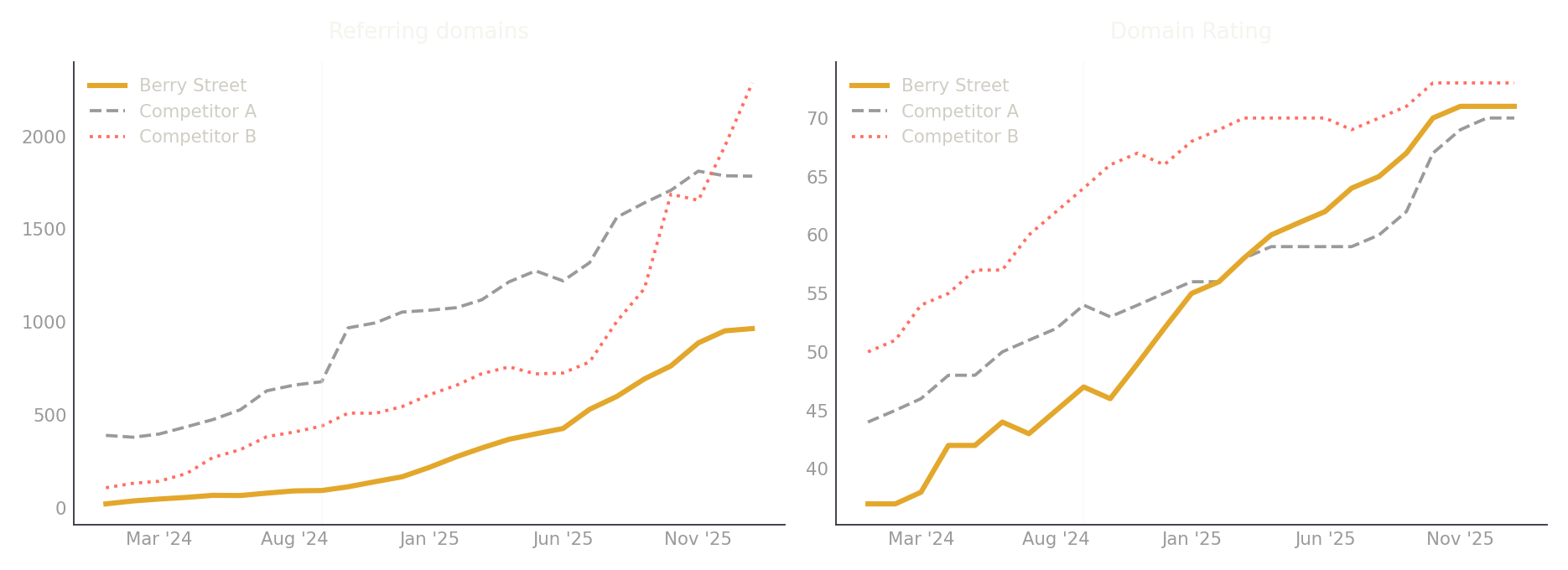
Rankings in healthcare are gated by trust signals. At the start of the engagement Berry Street had 93 referring domains and a Domain Rating of 45, which was a fraction of the two best-funded competitors in the category. Twenty-one months of disciplined, steadily-paced link acquisition closed most of that gap.
The pacing mattered as much as the volume. Both competitors show near-vertical referring-domain spikes in this period. Berry Street's curve is a straight line, which is exactly the type of growth Google tends to love, as you can see from the traffic.
The Proof, Keyword by Keyword
Owning the query that decides the booking
In insurance-billed care, one question precedes every conversion: is this covered? Berry Street now ranks on page one for that question - for the category term and for the individual carriers behind it. The payer cluster went from zero page-one rankings to 17 of 19.
Across the whole mapped set, 119 of 143 commercial keywords were not ranking at all in September 2024. By June 2026, 123 were ranking and average position had improved from 87 to 32.
| Target keyword | Agg. monthly volume | Before | After | |
|---|---|---|---|---|
| dietitian covered by insurance | 107,010 | 84 | → | 3 |
| blue cross blue shield dietitian | 1,220 | not ranking | → | 4 |
| united healthcare dietitian | 480 | not ranking | → | 4 |
| anthem blue cross dietitian | 100 | not ranking | → | 3 |
| emblem health dietitian | 60 | not ranking | → | 3 |
| harvard pilgrim dietitian | 30 | not ranking | → | 2 |
| carefirst blue cross blue shield dietitian | 10 | not ranking | → | 1 |
Volume is aggregate monthly search volume across all mapped variations of each target keyword. Positions from third-party rank tracking, single US location.
The Timeline
How it compounded
The Asset
Paid media is a subscription. SEO and GEO are assets on the balance sheet
The thing that matters the most to anyone underwriting a growth plan is not how much traffic a channel produces this month. It is what happens to that traffic when you stop paying for it.
Paid acquisition is rented. Volume tracks spend almost linearly, the auction reprices against you as competitors raise budgets, and the day the card stops, the patients stop. Every dollar buys one visit, once.
Organic works the opposite way. The 143 commercial landing pages built for Berry Street keep ranking. The 458 backlinks keep passing authority. The clinically reviewed articles keep being indexed, cited and clicked. That cost was incurred once, across 21 months - the ROI rolls in every month afterwards, with no media spend attached to it.
You can see the compounding in the data. Pages published in late 2025 were still climbing months later, because Google takes time to trust new URLs and then keeps rewarding them. The insurance-carrier pages that now sit at positions 1–4 took roughly six months to get there and have held those positions since. Nothing about that decays on a monthly billing cycle.
Which is why the honest way to price this work is not against one month's performance. A channel producing $511,000 a year in equivalent media value and roughly 4,800 incremental patient bookings a year, built once, is an annuity, and it is worth underwriting on that basis.
Built for What's Next
Already inside the answers, not just the links
Search is being rewritten around AI-generated answers, and most healthcare brands have no visibility into whether they appear in them. Berry Street is currently cited in 3,932 AI Overview results, which are the summary panels Google now places above the traditional listings, plus more than 1,300 People Also Ask placements.
Referral tracking for ChatGPT and other assistants was implemented during the engagement, alongside crawler access rules, structured content and FAQ formatting designed to be extractable by answer engines. That work was in place before most competitors began measuring the channel at all.
For Healthcare & Telehealth Brands
Your competitors are ranking for the question your patients ask first
If organic search isn't yet a measurable acquisition channel in your business, we'll show you exactly what it would take, the pages, the authority gap, and the realistic timeline.
Get A Free SEO & AI Growth Strategy