
We grew their organic traffic 663% and added $1,149,957 in revenue
MainClinicSupply sells FDA-cleared oxygen therapy equipment direct to patients at a $1,500–3,000 order value. In a category where paid acquisition eats the margin, they were spending $94,932 a quarter on ads to generate $144,074 in revenue. Twenty months later organic search was the cheapest revenue in the business, and the ONLY channel that kept compounding.
I thought ROAS was just about ad creative. But blending SEO with ads turned my entire funnel into a profit engine.
The Problem
A profitable store with an unprofitable growth model
Fran had built a genuinely good business selling portable oxygen concentrators, high-consideration medical devices at $1,500–3,000 a unit, bought by patients and caregivers who research heavily before purchasing.
For years Facebook and Google ads worked. Then competitors arrived, the auction repriced, and the old fix of "just spend more" suddenly stopped working as well as it used to. In Q3 2023 he put $94,932 into ads and got $144,074 in ad-driven revenue back. On a category with real COGS and shipping, that is close to breakeven.
The diagnosis was in one number. His blended CAC (cost to acquire a customer) was identical to his paid CAC, which can only happen when paid is the only channel. Every customer cost full auction price, and there was nothing in the mix to average it down.
The audit made the reason obvious. Of the organic traffic the site did have, 62% was people typing "main clinic supply" - customers who already knew the brand, mostly acquired by the ads he'd already paid for. On the searches that matter, someone comparing oxygen concentrators, someone researching what to buy, Fran's store was pretty much invisible.
The Strategy
Buy the traffic once, not every month
The counterintuitive part: this was never only an SEO project. Organic traffic that converts immediately lowers the cost of acquisition directly. Organic traffic that doesn't convert gets captured by the ad pixels and retargeted with their existing paid media strategy, which significantly brings down the cost per purchase/acquisition. The goal was for SEO to feed the paid engine instead of competing with it, and here's how we went about achieving that...
- 01
Fix the technical foundation first
A full Shopify audit surfaced subdomain hosting problems, spammy inherited backlinks, broken URLs and an unoptimised store structure. All resolved inside 16 days, which alone produced a 37% organic traffic lift in under 45 days.
- 02
Map the entire category, not just the products
95,000+ keywords extracted and clustered into commercial and informational intent, then mapped to existing collection and product pages or to new pages where nothing existed.
- 03
Publish across the full funnel
126 keyword-optimised pages and articles covering purchase-intent queries, comparison research, and the questions patients ask months before they buy.
- 04
Build the authority to hold the rankings
215 backlinks from domains rated DR 50+, prioritised toward the commercial pages carrying purchase intent.
- 05
Open a second language
108 Spanish-language pages now rank in the top 5 for terms like concentrador de oxigeno portatil - a large, under-served US patient segment almost no competitor in this category serves.
- 06
Wire SEO into the ad account
Organic visitors who didn't convert were retargeted with hyper-relevant creative, turning free traffic into a warm audience the paid team could close at a far better return.
The Results
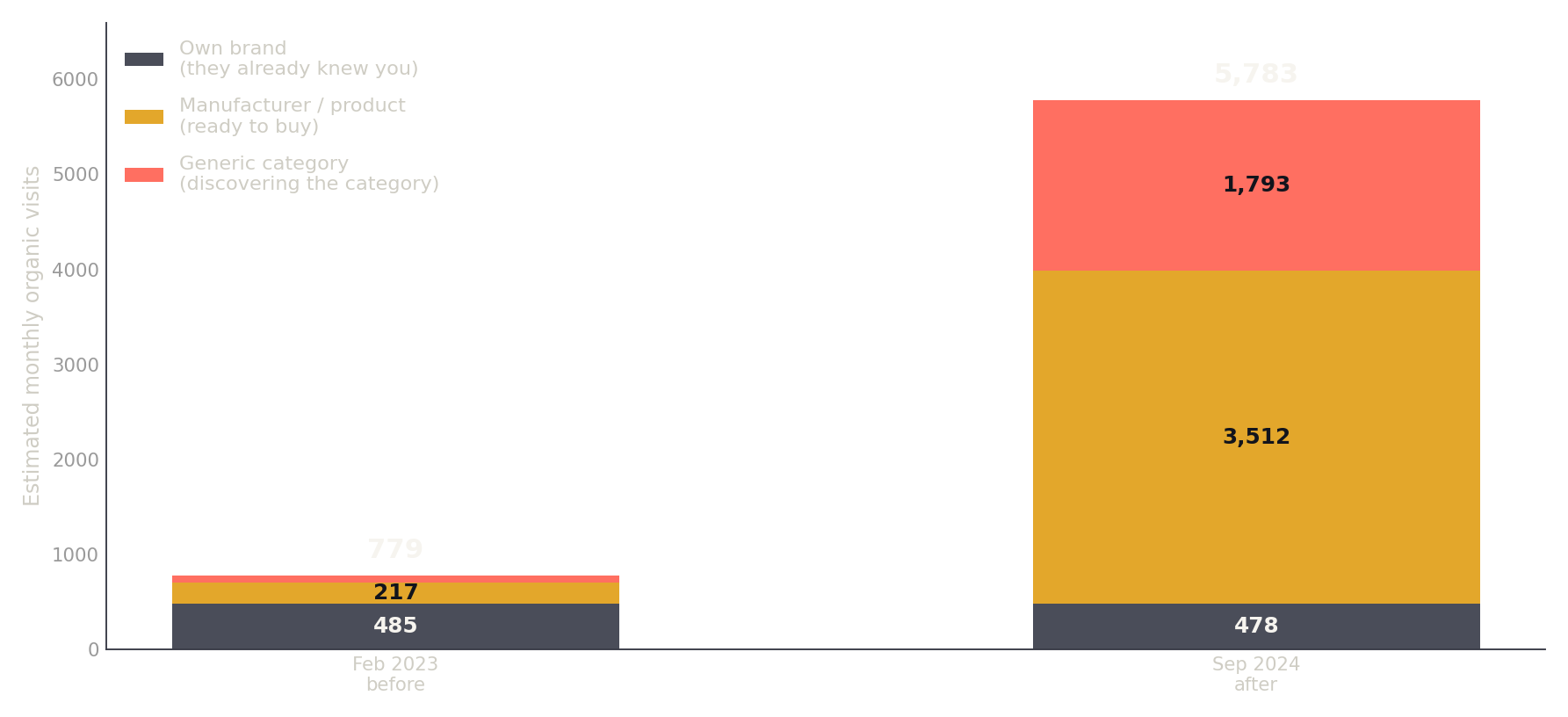
Brand traffic didn't move. Everything else grew 18×
This is the chart that matters, and it is the one most agencies would never show you. Searches for the company's own name were flat across the entire engagement, 485 visits a month before, 478 after. Not a single point of the growth came from people who already knew the brand.
Every visit that was added came from demand the business did not previously touch: people searching for the products it sells, and people still working out what to buy.
Manufacturer and product searches grew 16× from 217 to 3,512 visits a month. These are people typing exact model names, comparing prices, checking specs. In retail, that is the bottom of the funnel.
Generic category searches grew 23× from 77 to 1,793 visits a month, across 454 keywords now ranking on page one against 35 before. That is the top of the funnel, and it is what feeds the retargeting pool.
The Economics
What it did to the P&L
Traffic alone doesn't mean much... The reason this engagement mattered is what it did to the cost of buying a customer.
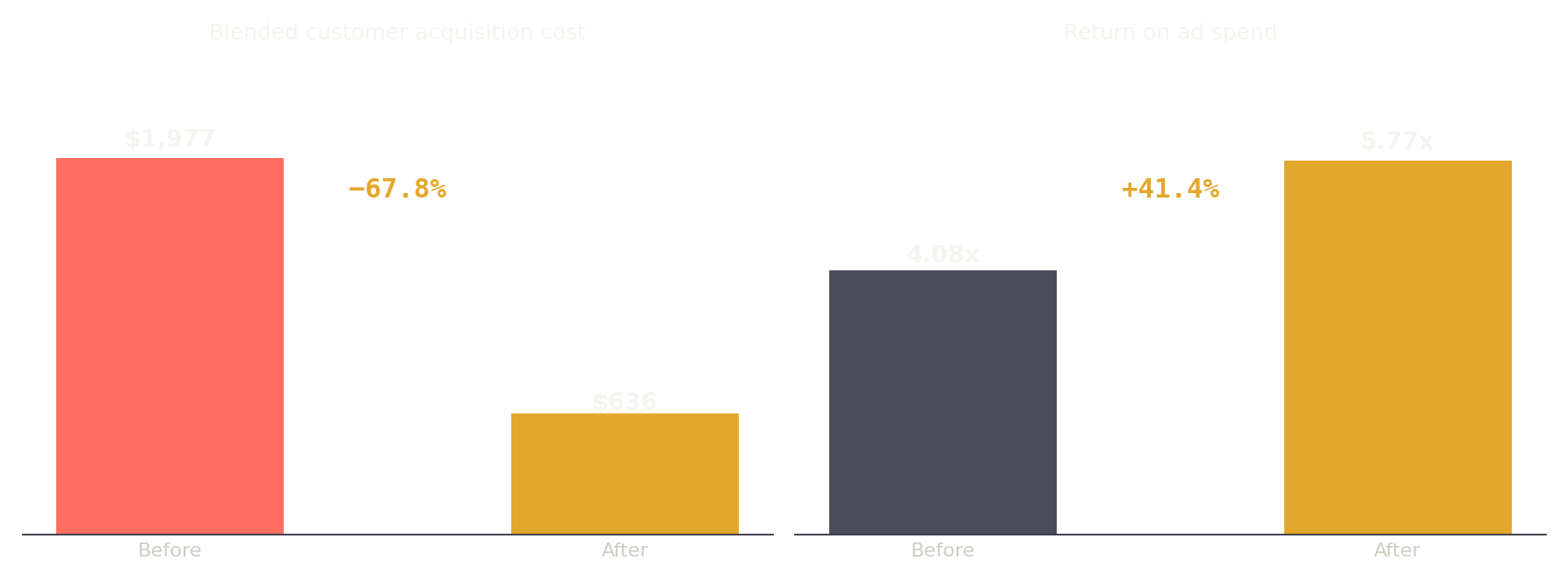
Blended CAC fell 67.8%, from $1,977 to $636. On a $1,500–3,000 order value, that is the difference between a business that breaks even on acquisition and one that can scale. It is also a structural advantage: Fran can now outbid competitors who are still paying full auction price, or take the margin instead.
ROAS rose 41.4%, from 4.08x to 5.77x, not by finding better creative, but by pointing the ads at an audience that had already visited the site through organic search.
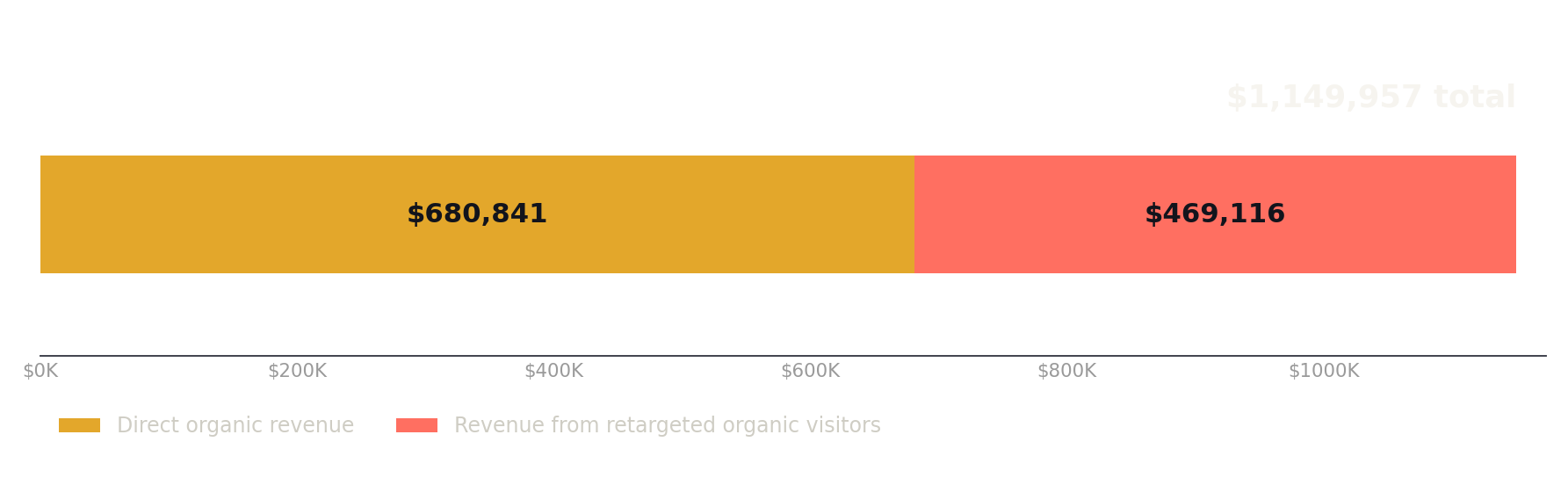
$680,841 came directly from organic search, at a cost per click of $0. A further $469,116 came from retargeting the organic visitors who didn't buy on the first visit - traffic that was already paid for, converted through the ad account at a fraction of cold-audience cost.
Independently of those figures, the organic traffic the site now holds would cost approximately $156,000 a year to buy through Google Ads at the blended cost-per-click of the keywords it ranks for. That is a recurring media line item the business no longer has to fund.
Revenue, CAC and ROAS figures are from GoldenWeb's engagement reporting and cover the first 12 months. Traffic, keyword and traffic-value figures are from Ahrefs, comparing February 2023 against September 2024.
The Proof, Keyword by Keyword
From invisible to page one on the searches that convert
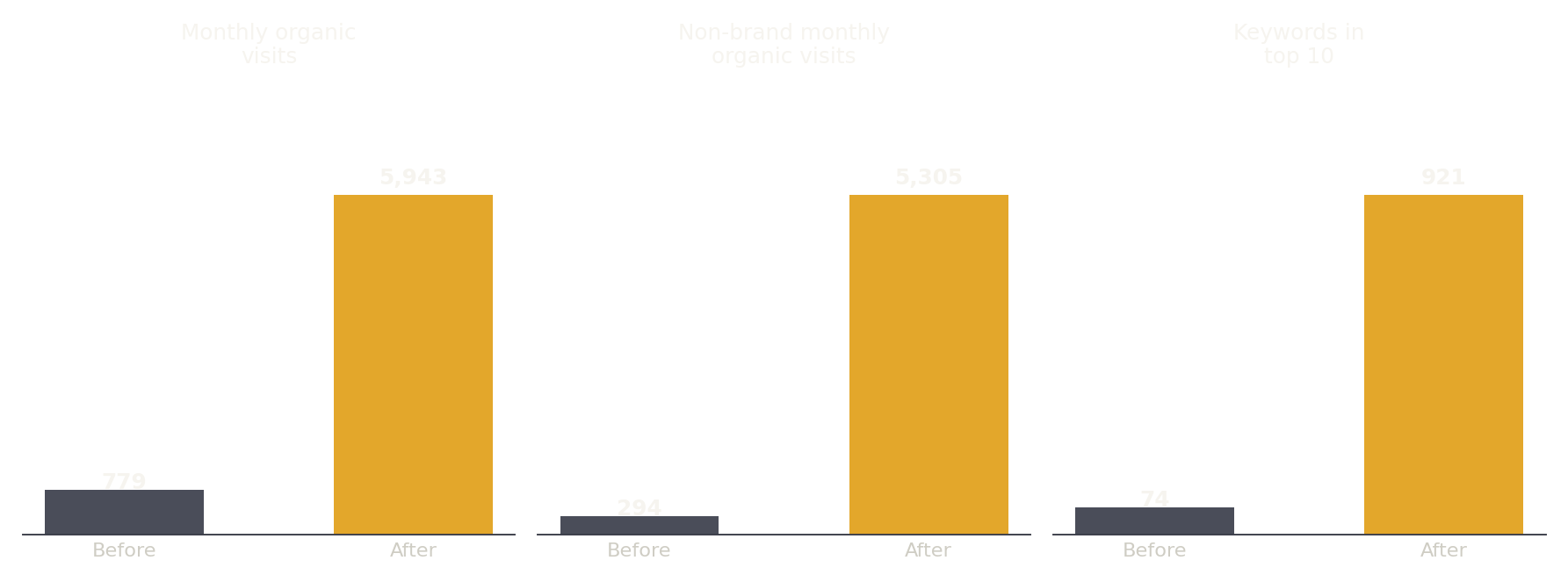
Across the site, keywords ranking in the top 10 went from 74 to 921. A sample of what that looks like in practice:
| Keyword | Monthly volume | Before | After | |
|---|---|---|---|---|
| home oxygen concentrator | 2,200 | not ranking | → | 10 |
| oxygen tubing | 1,800 | not ranking | → | 8 |
| oxigeno portatil | 1,200 | not ranking | → | 5 |
| concentrador de oxigeno portatil | 700 | not ranking | → | 4 |
| disadvantages of oxygen concentrator | 500 | not ranking | → | 8 |
| who buys used oxygen concentrators near me | 200 | 6 | → | 1 |
| sell oxygen concentrator near me | 150 | 11 | → | 1 |
| smallest oxygen concentrator | 200 | not ranking | → | 7 |
Two of those deserve a note. Ranking #1 for "who buys used oxygen concentrators near me" doesn't acquire a customer - it acquires inventory, feeding the buy-back program at zero sourcing cost. And the Spanish-language rankings open a US patient segment that essentially no competitor in this category is serving.
The Asset
Paid media is a subscription. This is something you own
The reason blended CAC is the right metric - and the reason investors in this category ask about it - is that it exposes whether a business has any acquisition leverage at all.
A store running purely on paid has none. Volume tracks spend linearly, the auction reprices against you every time a funded competitor enters, the profitability suffers... And it suffers big.
The 126 pages, 215 backlinks and 921 top-10 rankings built here don't work that way. The cost was incurred once. The rankings keep delivering, the retargeting pool keeps refilling, and the marginal cost of the next organic visit is zero. That is why Fran's real advantage isn't the $1.15M, it's that competitors are still paying $1,977 to acquire a customer now cannot follow him down.
For DTC Medical & Healthcare Brands
If your blended CAC equals your paid CAC, you don't have a channel problem. You just have one channel
We'll show you exactly where the high-intent organic demand sits in your niche, what it would cost to take it, and how fast it would move your blended CAC.
Get a Free Mini SEO & AI Audit →